Southern Spain 2025
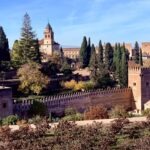

When I hitchhiked through Spain with my girlfriend in 1963 on our way to Morocco, we stopped in Seville for a couple of days before taking the ferry to Tangiers. I was struck by the similarities in home architecture with towns in India and by the words we share in Hindustani. On that trip, I also had my first Paella and saw a Flamenco performance in a nightclub. I long remembered the saffron-flavored rice with spicy chorizo and the restrained passion of Flamenco dance, music, and singing. Some of these influences were also apparent in Morocco, with the additional blending of French culture from its brief colonial period. As I learned more about the region’s history, I came to understand that Middle Eastern culture, Arabic, and Islam had influenced Morocco, Spain, and India.
Muslim Moors ruled Al-Andalus in Spain, including the area I visited, on and off from about 711 to 1492, when it came fully under Christian control. The Umayyad Caliphate in the Middle East inspired the initial conquest, but the army was mainly composed of Berbers from Morocco and Algeria. In fact, the first invasion was led by Tariq ibn Ziyad, a Berber commander. Most of the ruling class were Arab, and the soldiers were Berber, collectively known as Moors. Over time, Berber dynasties began ruling parts of Al-Andalus as governance fragmented. Arabs brought with them accumulated knowledge of philosophy, mathematics, medicine, astronomy, architecture, new crops, irrigation systems, and cuisine that have had a lasting influence on Spain.
Al-Andalus was established as an emirate and later as the Caliphate of Cordoba in 929, lasting until 1031. During the Caliphate, knowledge and cultural exchange thrived, with Muslims, Christians, and Jews coexisting and contributing to advancements in knowledge. When the Caliphate fell apart, several smaller Muslim kingdoms called “Taifas” emerged. This fragmentation of authority weakened Muslim rule, prompting Christian kingdoms to begin the “reconquest” of the region, which culminated in the fall of the Emirate of Granada in 1492. Afterward, the Moors and Jews were forced to convert to Christianity or leave Spain with their basic possessions, but they were not allowed to take precious metals or jewelry. This marked the end of a long period of peaceful coexistence among those religions.
In early 2024, I revisited Morocco on a tour arranged by Overseas Adventure Travel (OAT). OAT previously offered a post-trip extension to Southern Spain, but it was discontinued. Feeling my curiosity about the area’s cultural blend was not sated, I looked for another tour company that covered Southern Spain and found a Gate 1 tour.
Madrid
Madrid comes from the Arabic “Mayrit,” meaning “place of abundant water” from aqueducts. The Moors established it as a frontier fortress and ruled for 300 years until the Christian reconquest in 1085. The town gained prominence in the 16th century when Emperor Charles V chose it for his Royal Court. Later, in 1561, King Philip II declared it the capital.
The tour’s start in Madrid felt too brief, basically just a day, so I flew in a day early to comfortably visit the city’s famous art museums, walk through its old, narrow, winding streets, and try some of its local foods and wines. I spent my first day exploring three museums. I easily reached the Prado from my hotel on Plaza de España by taking a free bus, then walked a short distance to the other two. Based on a royal collection, the Prado is huge, housing thousands of paintings by European artists, especially Spanish, from the 12th to the 20th century. I moved through the collection in awe, even though realistic paintings aren’t my favorite. My guidebook recommended a close examination of Diego Velázquez’s Las Meninas, Francisco Goya’s Third of May, and Hieronymus Bosch’s Garden of Earthly Delights. These were stunning works, and I’d also include Goya’s Second of May among them. While looking at Bosch’s work, a woman in her 30s suddenly stepped right in front of me, blocking my view. When I pointed this out, she replied that it was a public place and she could stand wherever she wanted—that’s the joy of tourism! Luckily, I had seen that painting at my own pace during an exhibit in Budapest a couple of years earlier.
The Reina Sofía Museum, inaugurated by Queen Sofía in 1992, houses a vast collection of contemporary art. It was partially under renovation and somewhat hard to navigate, but Picasso’s Guernica, Miro’s “Woman in Blue,” Dali’s “The Great Masturbator,” and Picabia’s “Amsel au Sagesse” were engaging.
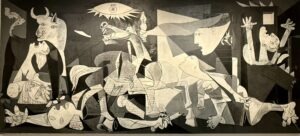
Picasso’s Guernica
The Thyssen-Bornemisza had an eclectic collection of Western art from the 13th to the 20th centuries. I liked Picasso’s “Matador and Nude,” Albert Gleizes’s “In Port,” Matta’s “Dazzling Outcast,” an abstract by Kandinsky, and Hopper’s “Hotel Room.”
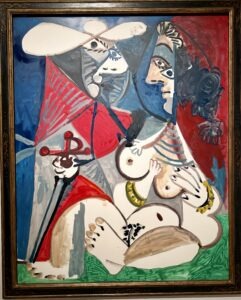
Picasso: Matador and Nude
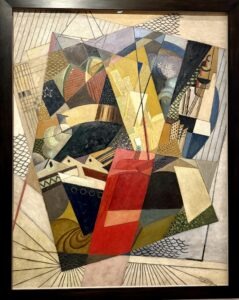
Gleisen: In Port
In the evening, using a hotel map and my iPhone’s navigation, I found Mercado San Miguel near Plaza Mayor in the historic part of the city. It is a cast-iron building that opened as a wholesale food market in 1916 and now functions as a covered gourmet market with around 50 stalls and shops selling produce and regional specialties. The many options made choosing difficult, but I enjoyed a chili-lobster roll, various seafood tapas, and a few bite-sized flavored cheesecakes, all paired with a white Garnacha wine. It’s easy to overeat with small bites, but I had burned calories from 10 miles of walking.
.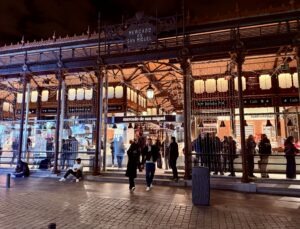
Mercado San Miguel
The Gate I tour began the next morning with a coach ride through Madrid, passing the main architectural sites, including the Royal Palace (in use for a function), gardens, museums, the train station, and other landmarks. We got off the coach near Plaza Mayor and walked back to our hotel, passing the theater and the National Assembly building, then to Plaza de España, where there is a statue of Cervantes and Christmas decorations.
In the afternoon, about ten of us chose to tour the Royal Hunting Lodge, Monastery, Basilica, Library, School, and burial vault for Spain’s Kings and Queens at El Escorial, about 28 miles northwest of Madrid. Finished in 1584 and designed by an architect who also helped build St. Peter’s Basilica in Rome, it is the largest Gothic structure. We walked through the complex with a guide who explained its history and main features. A large painting of the Last Supper by Titian was striking, as was the library’s painted ceiling.
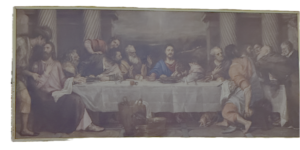
Titian: Last Supper
Back in Madrid, I headed to Mercado San Miguel, having noticed a stall offering Paella. I got the last but one portion of the Seafood version. Sadly, it tasted stale, showed no sign of Saffron, and I had to search for the few pieces of seafood, but thankfully, the white Garnacha saved the meal.
Toledo
The drive to Toledo the next morning took over an hour, slowed by the rush hour in Madrid. Our coach dropped us off near a bridge over the Tagus River, which led to a winding, narrow road through the Jewish quarter of small dwellings. Toledo became a “Taifa” after the collapse of the Cordoba Caliphate and remained important after coming under Christian rule in 1085, while still hospitable to Jewish and Muslim influences. It is now the capital of the Castilla— La Mancha province and was home to Cervantes and El Greco. It has a massive Gothic cathedral, is the birthplace of Manchego Cheese, and is a UNESCO World Heritage Site.
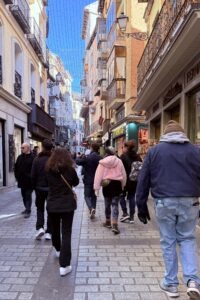
Toledo Street
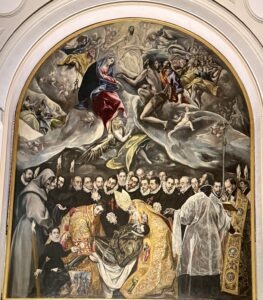
El Greco
Toledo has a history of producing fine-bladed weapons decorated with Damascene craftsmanship and is the largest producer of Damascene handicrafts, according to a young woman from Kerala, India, whom we met at a workshop we visited. We saw the impressive painting by El Greco in a church, which was apparently a breakthrough in his craft. We wandered through lanes lined with shops on both sides, some offering a taste of Marzipan, the town is famous for, but I don’t enjoy, to the main square, crowded with tourists and locals selling their wares. I sat on a bench and had a sandwich for lunch, soaking up the sunshine and watching people, trying to identify the many languages they spoke.
Granada
Back on our bus, it took about four hours to reach Granada. The rolling landscape was mainly covered with olive trees, with a few patches of vineyards or fallow land. The snow-capped, majestic Sierra Nevada appeared as we approached Granada. After checking into our modern hotel, I was eager to stretch my legs after hours of sitting. I asked the hotel for directions to the city center. I walked along the main road for about twenty-five minutes, and then I noticed a hub of activity. I entered Castaneda, an energetic place bustling with people of all ages. It had legs of ham hanging from hooks above the bar. In broken Spanish, I ordered red wine, which was served with tapas, a tortilla. I tried to engage my neighbor in conversation, but he said he didn’t speak English or wasn’t interested. Anyway, I was content to be a bystander, listening to the animated banter around me. As I left, I noticed the narrow road above and parallel to the main road. It turned out to be at the heart of the old town, with small shops of all kinds lining the street. I passed a few boutique hotels along the way and wished we were staying in one.
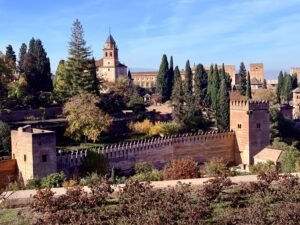
Alhambra View
The next morning, we drove up the hill above the town to the Alhambra. Our first stop was the unfinished Renaissance palace built by Charles V, beside the Alhambra. At the entrance to the Nasrid palaces, we had to show our timed tickets and passports. Our local guide, who was both knowledgeable and humorous, led us through the different parts of the Alhambra complex, explaining the main features of the Courtyard of the Myrtles, Hall of the Ambassadors, Courtyard of Lions, and the King’s living rooms with their intricately carved columns, magnificent ceilings, and window niche carvings — an overwhelming display of Islamic art, more than I could take in during a walk-through. I wanted to return and spend a few hours examining the carvings more closely. We were also shown Washington Irving’s room. His book, “Tales of the Alhambra,” which I was reading, rekindled interest in the complex.
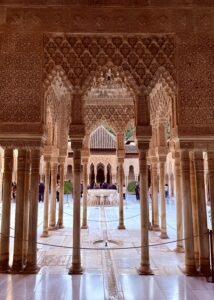
Courtyard of Lions
We walked from the main building to the summer palace known as Generallife, where, in a huge irrigated garden, fruits, vegetables, herbs, and flowers are cultivated. At one end, a modern outdoor theater was built in the 1950s that serves as a concert venue.
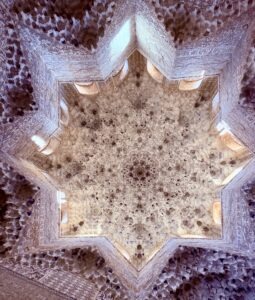
Alhambra Ceiling
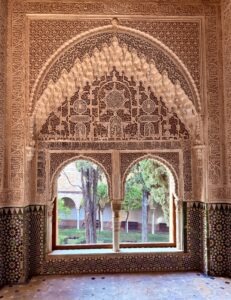
Alhambra Window
Seville
The coach took about three hours from Granada to our modern hotel in Seville in the late afternoon. Seville is a bustling, modern city with a 2,000-year-old history and is the capital of Andalusia. Historically, it was a rich area, especially when it was Spain’s main port during the colonization of South America. It welcomed the blend of Muslim, Jewish, and Christian people and cultures.
As our two nights here effectively marked the end of our tour, I sought to satisfy my gastronomic interest in a good Paella and Lubina a la Sal (Seabass cooked in salt). Restaurants serve both dishes, as it turned out, for at least two people. On the first evening, a couple on the tour and I visited Bendala Arroceria, which our trip leader had recommended. The Scallop Paella was much better than at Mercado San Miguel, but delicate rather than spicy, bereft of saffron, and I had to search for the scallops. Fortunately, the white wine made from Treixadura grapes from Galicia was fruity with a hint of pear, paired well with my dish, and was a new taste experience for me. After dinner, we walked back to the hotel, stopping at the huge Plaza de Espana, a semicircular structure with a colorfully lit fountain at its center.
The next day, we were given a tour of Seville’s main sites, including the Plaza de España, built for the 1929 World’s Fair, where the colorfully tiled scenes and maps of every province are presented in a semicircular arc at the foot of the imposing main pavilion. We walked through Barrio Santa Cruz, formerly the Jewish neighborhood, with its narrow lanes and small plazas, more reminiscent of my visit decades ago. The main sites were the Royal Alcazar, a Moorish Palace repurposed for later Christian kings, but retaining its Islamic architecture, carvings, and gardens. Nearby, the largest and ornate Gothic Cathedral, with a massive bell tower that is a repurposed minaret, housed the tomb of Christopher Columbus. More time and explanation to appreciate these sites would have been welcome.
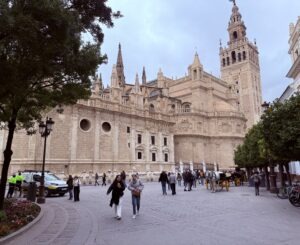
Seville Cathedral
After the tour, I had lunch at the recommended, elegant La Isla restaurant, where Lubina a la Sal was on the menu. Unfortunately, their smallest Seabass could feed at least three people, so I ordered the special of the day: Sole on a bed of Mushrooms with a delicate Pumpkin sauce. The creamy, full-bodied Chardonnay from Castilla, with a citrus finish, almost overpowered the Sole, but on its own, it was excellent.
Our evening’s program was to watch a Flamenco show in an auditorium rather than a nightclub, which I would have preferred. En route, our trip leader explained that the dance was created by gypsies who migrated from Punjab, India, centuries ago, blending their heritage with Andalusian, Moorish, and Sephardic Jewish influences. I have been drawn to Flamenco music and dance since I first heard and saw it in 1963, and now I know why: I, too, am from Punjab. The performance was good, not outstanding, but enjoyable, nonetheless.
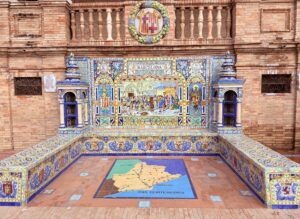
Barcelona Bench at Plaza de España
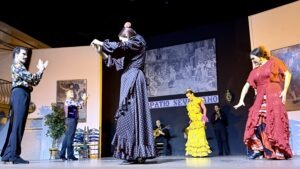
Flamenco
Cordoba
The next morning, our coach took us to Córdoba, about a two-hour drive away. We stopped to explore the Mezquita, a massive former mosque that once stood at the heart of Islam in Andalusia, comparable in cultural importance to Baghdad. About a hundred years after the fall of the Caliphate of Córdoba, the mosque was dedicated as a Catholic church, with structures added over the following centuries, including the impressive tower built atop the minaret. The large space, supported by decorated arches, features a Mihrab and an altar. From an area with a glass-covered floor, you can see the earlier Visigothic ruins. Córdoba was home to philosophers such as Maimonides, Averroes, and Seneca.
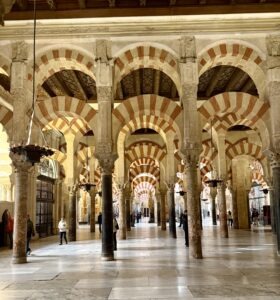
Cordoba Mosque-Cathedral
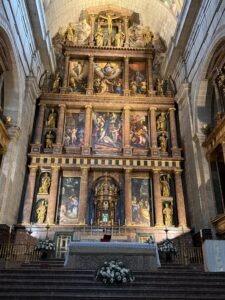
Córdoba Alter
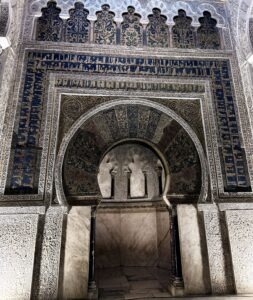
Córdoba Mihrab
The four-and-a-half-hour drive back to Madrid was tedious and tiring. We arrived around 6 pm, which gave me enough time to wash my clothes at a nearby laundromat and enjoy a glass of wine at a local bodega between cycles. I finished just in time to join the tour for our farewell dinner at the nearby Best Princesa. Although I can’t remember exactly what I ate, it was good, and the company was lively, making for a fitting end to our visit.
Conclusions
The tour was somewhat hurried. My decision to add an extra day in Madrid was a good one, and I would have preferred another day in Granada and Seville/Cordoba to absorb the ambiance. We stayed at the Riu Plaza de España in Madrid, Catalonia in Granada, and at the Meliá Lebreros in Seville. They were rated four stars and were accordingly comfortable. All were close enough to the old parts of the cities, but I would have preferred hotels there to get the full flavor of our visit. Although 22 people on the tour were apparently small for Gate 1, more meals together would have helped to get to know the tour members better. Finally, our trip leader and guide for El Escorial and Toledo were excellent, and the others were good as well, which informed our visit.